



Eye-protecting ingredients or add another powerful fighter! This “antioxidant star” can alleviate myopia.
Myopia, as one of the most common vision problems worldwide, affects people’s daily lives. Currently, the global prevalence of myopia is increasing rapidly. It is predicted that by 2050, 49.8% of the world’s population will be affected by myopia, and 9.8% will have high myopia.
How does quercetin alleviate myopia?
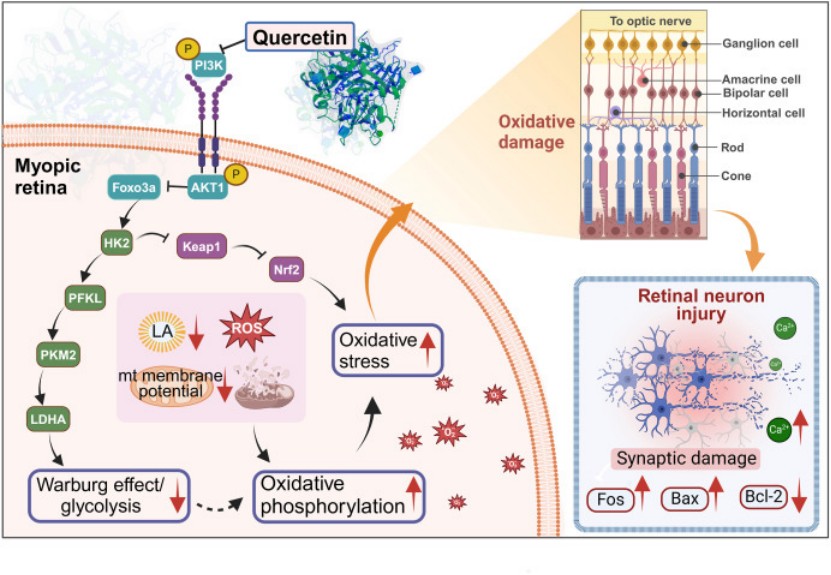
The retina is the core structure for visual formation and relies on glycolysis to maintain normal physiological functions. Therefore, it is prone to oxidative damage. Retinal oxidative stress is one of the key factors that induce and aggravate myopia.
Researchers have found that during the progression of myopia, the AKT/FOXO/HK2 pathway becomes abnormally activated and inhibits glycolysis. Protein interaction and dual luciferase experiments have confirmed that a decrease in glycolysis levels promotes oxidative phosphorylation, causes retinal oxidative damage, and thereby accelerates the progression of myopia. In addition, excessive Fos expression promotes retinal cell apoptosis, alters the structure and function of retinal neurons, and aggravates the degree of myopia.
“Antioxidant Star”: Quercetin “Quercetin, also known as oak tannin or buckthorn flavonoid, was discovered by the Hungarian physiologist Szent Gyorgyi in 1936. Quercetin is a type of flavonoid compound, widely present in fruits and vegetables such as apples, tomatoes, grapes, and onions, as well as in medicinal plants such as ginkgo leaves and forsythia.”
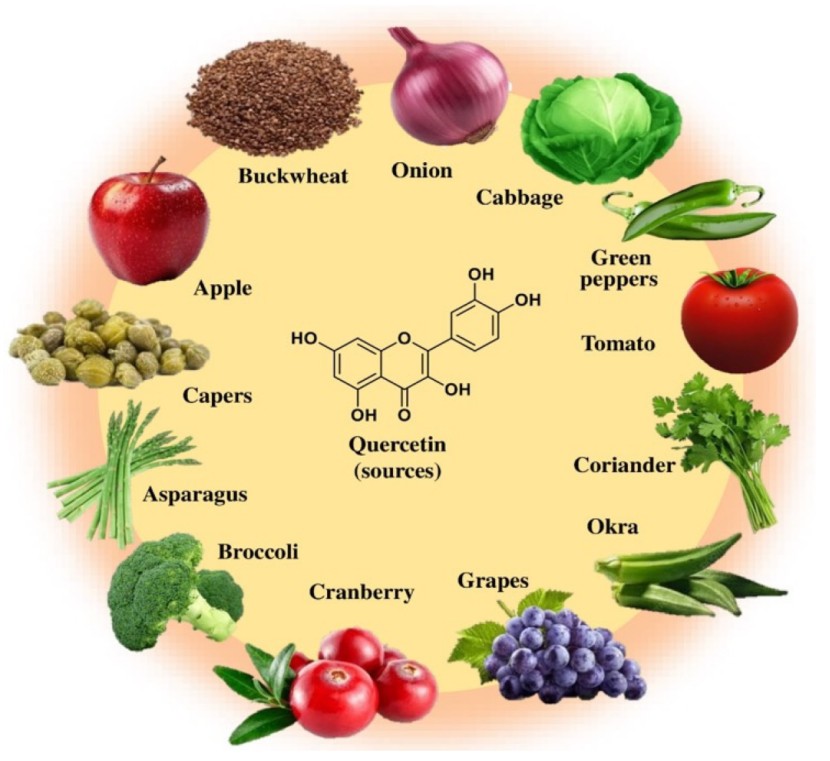
The research has found that quercetin is one of the most effective free radical scavengers within the flavonoid family and is a potent antioxidant component. Quercetin can regulate various cellular pathways, including the NF-κB and MAPK signaling pathways that play crucial roles in inflammation and oxidative stress. Compared to other flavonoids, quercetin can directly neutralize reactive oxygen species and has extremely strong antioxidant capabilities, making it the “antioxidant star” among natural flavonoid substances.
In 2010, quercetin was certified by the FDA as GRAS (Generally Recognized as Safe), and can be used in beverages, cereal products, pastries, processed fruits and juices, and gummy candies, with a maximum of 500 milligrams per serving. In Japan and South Korea, quercetin can also be used as a food additive.
More benefits of quercetin
Numerous studies have shown that quercetin has various benefits, including immune support, antioxidation, anti-depression, anti-diabetes, prevention of obesity, neuroprotection, and heart protection.
1) Anti-depression studies have found that in a mouse model of depression induced by lipopolysaccharide (LPS), quercetin significantly alleviates the depressive behavior and related cognitive impairments of the model mice by inhibiting the activation of the NLRP3 inflammasome and the neuroinflammatory process.
In addition, a meta-analysis indicates that quercetin shows significant anti-depressive effects in animal experiments. Its potential mechanism may involve regulating oxidative stress, inflammatory response, neurotrophic factors, and the function of the hypothalamic-pituitary-adrenal (HPA) axis.
2) Prevention of obesity: Studies have found that in C57BL/6 mice, quercetin can alleviate obesity and metabolic dysfunction induced by high-fat diet (HFD), and induce adipose tissue remodeling. At the same time, quercetin in 3T3-L1 preadipocytes can inhibit fat formation and limit adipocyte hypertrophy.
In terms of the mechanism, quercetin activates the AMPK-DAPK3-ULK1 signaling axis, thereby upregulating isoform-specific DAPK1 and DAPK3, and subsequently inducing fat autophagy, which is mediated by the lysosomal acid lipase (LIPA) hydrolysis, promoting the lysosomal degradation of lipid droplets.
3) Liver protection: Quercetin can exert liver-protective effects by reducing ALT and AST levels, alleviating inflammation and oxidative stress, and protecting liver and kidney tissues.
Studies have found that quercetin reduces inflammation and fibrosis in mice by inhibiting the inflammatory pathways of IL-1β/iNOS and IL-1β/CD45 in the liver, while also inhibiting the reduction of endogenous metabolites and alleviating cell apoptosis, thereby alleviating non-alcoholic fatty liver disease.
4) Anti-allergy: In preclinical models, quercetin can exert anti-allergic effects by inhibiting IgE expression, regulating immune cells, regulating the cytokine network, and inhibiting histamine release.
5) Immune support: Studies have found that quercetin has the effect of enhancing immunity. Quercetin can alleviate radiation-induced inflammatory damage by increasing cytokine secretion, while also improving myocardial oxidative stress damage and immune dysfunction caused by isoproterenol.
Quercetin has low water solubility (only 0.01 mg/ml), poor stability, and low bioavailability (about 2%). Currently, there are five main ways to enhance the bioavailability of quercetin on the market.
In dietary supplements containing quercetin, common dosage forms include capsules, drops, and gummies, among others. The claimed benefits include supporting immune health, anti-aging, antioxidation, and supporting joint health, etc.
Post time: Jun-02-2026