



In recent years, the global obesity problem has become increasingly severe. According to the “Global Obesity Atlas 2025″ released by the World Obesity Federation, the total number of obese adults worldwide is expected to increase from 524 million in 2010 to 1.13 billion in 2030, an increase of over 115%. Against this backdrop, an increasing number of consumers are seeking natural ingredients that can help prevent obesity. In June this year, a study published in the journal “npj science of food” pointed out that curcumin alleviated visceral fat accumulation in MASH rats by inhibiting the release of gastric inhibitory polypeptides (GIP) caused by hypoxic intestinal injury. This discovery not only provides new ideas for anti-obesity but also broadens the application market of curcumin.
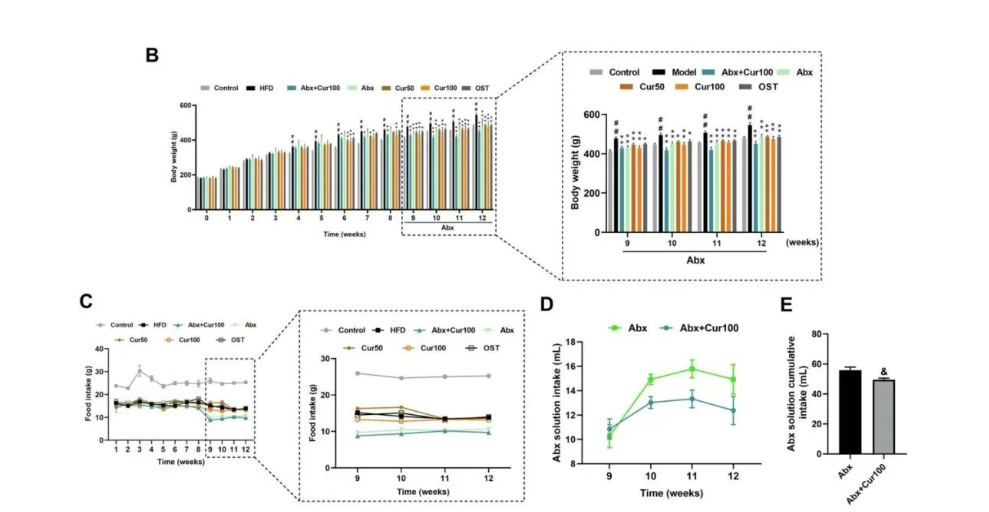
How does curcumin inhibit the accumulation of visceral fat? Visceral fat accumulation refers to abnormal or excessive fat accumulation. High-carbohydrate, high-fat diets and lack of exercise can all lead to energy imbalance, thereby causing excessive visceral fat. The gastrointestinal tract is a key area for fat absorption. Visceral fat accumulation is an important feature of metabolic dysfunction-related steatohepatitis (MASH). According to the research, both curcumin and antibiotics can reduce the body weight of MASH rats, and curcumin and antibiotics have a synergistic effect.
Mechanism research has found that curcumin mainly reduces the weight of visceral fat, especially in the perirenal tissues. Curcumin inhibits weight gain by suppressing the release of GIP and reducing the adipose tissue index around the kidneys. Curcumin-induced reduction in intestinal GIP release inhibits the activation of GIP receptors, thereby alleviating adipogenesis and inflammation in perirenal adipose tissue. In addition, curcumin can alleviate small intestinal hypoxia by protecting the intestinal epithelium and vascular barrier, thereby reducing the release of GIP. In conclusion, the pharmacological effect of curcumin on visceral fat mainly weakens the release of GIP by inhibiting hypoxia mediated by intestinal barrier disruption.
Curcumin, the “anti-inflammatory expert”, mainly comes from the roots and rhizomes of Curcuma (Curcuma longa L.). It is a low-molecular-weight polyphenolic compound and is usually used as a seasoning in various foods. In 1815, Vegel et al. first reported the isolation of an “orange-yellow substance” from the rhizome of turmeric and named it curcumin. It was not until 1910 that Kazimierz and other scientists determined its chemical structure to be diferulic acylmethane. Existing evidence indicates that curcumin has a significant anti-inflammatory effect. It can exert its anti-inflammatory effect by inhibiting the Toll-like receptor 4 (TLR4) pathway and its downstream nuclear factor kB (NF-kB) signaling pathway, and reducing the production of pro-inflammatory factors such as interleukin-1 β(IL-1β) and tumor necrosis factor -α(TNF-α). Meanwhile, its anti-inflammatory properties are regarded as the basis of various biological activities, and a large number of preclinical or clinical studies have explored its efficacy in inflammatory diseases. Among them, inflammatory bowel disease, arthritis, psoriasis, depression, atherosclerosis and COVID-19 are the current hot research areas.
With the development of the modern market, curcumin is difficult to reach an effective dose through diet alone and needs to be taken in the form of supplements. Therefore, it has grown significantly in the fields of health food and dietary supplements.
Justgood Health has also developed a variety of curcumin gummy supplements and curcumin capsules. Many distributors have come to customize the unique dosage or shape of their own brand.
More research on the benefits of curcumin has found that curcumin not only helps resist obesity but also has multiple effects such as antioxidation, neuroprotection, relief of bone pain and support for cardiovascular health.
Antioxidant: Research has found that curcumin can directly eliminate free radicals and improve mitochondrial function by activating pathways such as silencing regulatory protein 3(SIRT3), thereby reducing the production of excessive reactive oxygen species (ROS) from the source and effectively alleviating cellular oxidative damage.
Neuroprotection: Existing research evidence indicates that inflammation is closely related to depression. Curcumin may improve the depressive and anxious symptoms of patients with depression. Curcumin can help resist neuronal damage induced by interleukin-1 β(IL-1β) and other factors, and alleviate depression-like behaviors caused by chronic stress. Therefore, it may play a positive role in supporting brain health and emotional regulation.
Relieving musculoskeletal pain: Studies have shown that curcumin can improve the clinical symptoms of arthritis model animals and protect joint and muscle tissues by reducing inflammation. Curcumin can relieve musculoskeletal pain because it can significantly inhibit the release of pro-inflammatory factors such as tumor necrosis factor -α(TNF-α) and interleukin-1 β(IL-1β), reduce local inflammatory responses, and thereby alleviate symptoms of joint swelling and pain.
Supporting cardiovascular health: In terms of the cardiovascular system, curcumin can function by regulating blood lipids, reducing serum total cholesterol, triglycerides and low-density lipoprotein cholesterol levels, while increasing high-density lipoprotein cholesterol levels. In addition, curcumin can also inhibit the proliferation of vascular smooth muscle cells and inflammatory responses, which is helpful in preventing the occurrence and development of cardiovascular diseases such as atherosclerosis.
Post time: Jan-08-2026